Les Jacqueries 2026: A Joyful Rebellion in the Heart of Brussels
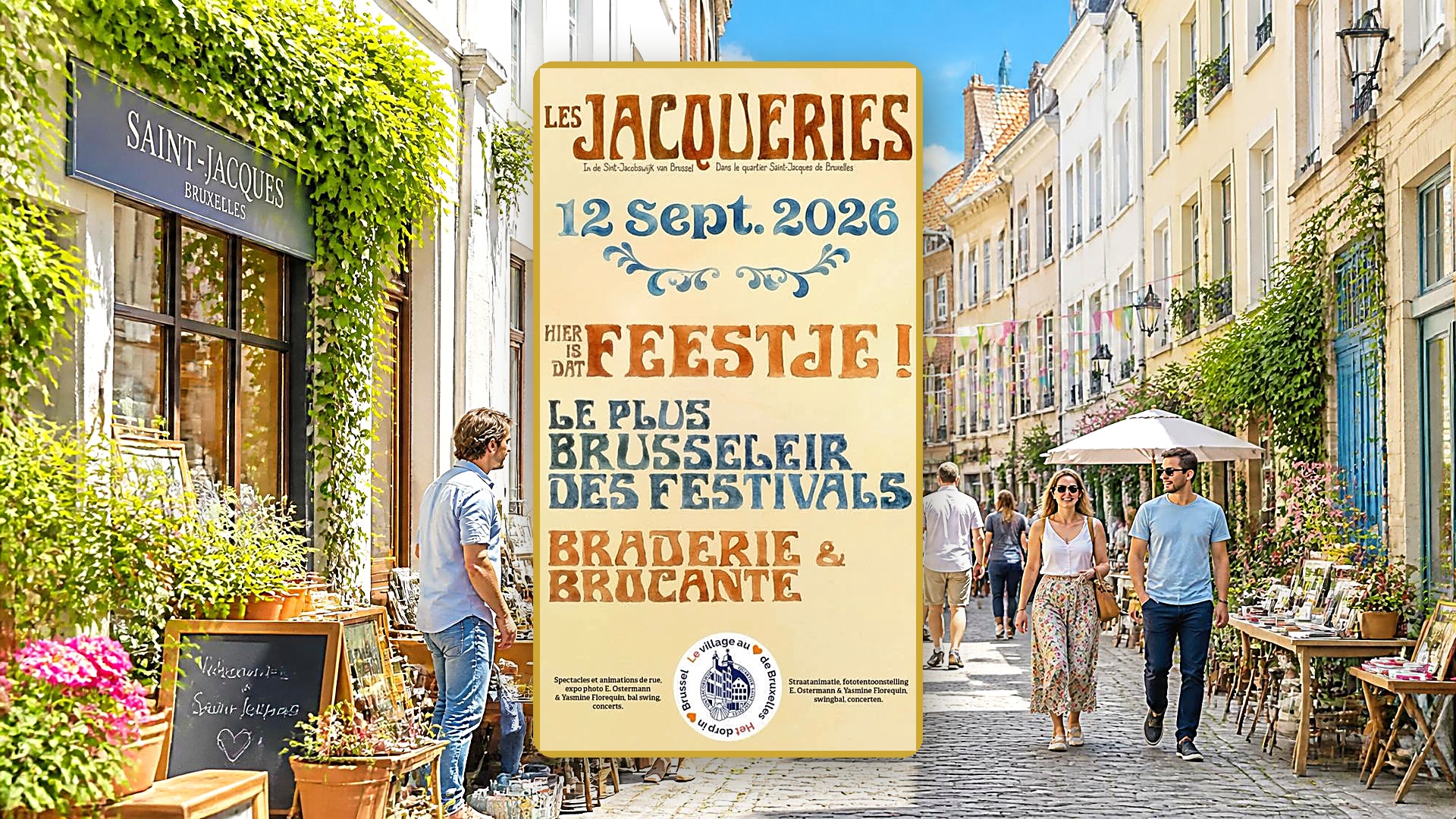
On 12 September 2026, from 2 p.m. to 10 p.m., the Saint-Jacques quarter will be transformed into an open-air stage.
Carte blanche
An article by Marie Struglia — Horeca consultant, founder of Horeca Talk Media, and a human media partner of BXLpositive.
What are Les Jacqueries? A Brussels street festival
On Saturday, 12 September 2026, the Saint-Jacques quarter will transform its narrow streets into an open-air stage. Performances, concerts, a brass band, wandering artists, activities, exhibitions, a major street sale, and a flea market will make up the sixth edition of Les Jacqueries, a festival that celebrates Brussels with humour, creativity, and a genuine love for bringing people together.
Some neighbourhoods you walk through while staring at your phone. Others eventually make you look up. Saint-Jacques clearly belongs to the latter category.
Behind Brussels' City Hall, around the Marché au Charbon, Rue du Midi, Rue du Lombard, and Place de la Vieille Halle aux Blés, its streets bring together heritage, independent shops, restaurants, artisans, culture, and Brussels folklore.
On 12 September, this whole community will take to the streets. The festival will run from 2 p.m. to 10 p.m. An uprising is indeed on the cards. But rest assured: it will be one of music, zwanze (Brussels' trademark humour), new encounters, and great bargains.
The story behind the festival’s rebellious name
The name deserves a little explanation. Historically, a jacquerie refers to a peasant revolt that occurred in France in 1358, while King John the Good was held captive. The word comes from the name Jacques, once used as a nickname for peasants in the expression “Jacques Bonhomme.” By extension, a jacquerie came to mean any popular revolt.
In the Saint-Jacques quarter, the term has thankfully been reinterpreted. No castles to storm, no nobility to chase away, and, barring a very bold change to the programme, no official use of pitchforks.
The rebellion will be artistic and resolutely Brussels-style: street artists, musicians, actors, jugglers, magicians, and a brass band will take over the streets, with concerts, exhibitions, and activities from local shops.
Discover the Saint-Jacques quarter, a village in Brussels
The Saint-Jacques quarter bills itself as a village in the heart of the capital. Located in the very centre, between the Sablon, Saint-Géry, and Dansaert, it grew around the Notre-Dame de Bon Secours church and the Rue du Marché au Charbon. The neighbourhood association points out that it has over a thousand years of history.
This long history can still be seen in its winding streets, its facades, the remains of the Villers wall, and the Bon Secours church. But Saint-Jacques is no museum piece: residents, shopkeepers, artisans, artists, and visitors mingle here every day.
A few famous figures also stand guard. Manneken-Pis observes visitors with his well-known professional seriousness. Madame Chapeau awaits passers-by on Rue du Midi. Jacques Brel welcomes the public at Place de la Vieille Halle aux Blés. Three excellent landmarks — even if only one of them seems truly equipped to handle a heatwave.
A wandering festival with street performers and live music
Les Jacqueries isn’t just about a main stage. The real joy comes from wandering around.
You might be heading to a concert and stumble upon a magician on a street corner. You could follow a brass band, discover a shop you’ve never entered before, pause at an exhibition, or run into an actor while simply looking for a terrace. The neighbourhood itself becomes part of the show: the audience doesn’t just watch the event, they find themselves right in the middle of it.
The first major flea market in the Saint-Jacques quarter
The sixth edition will also host the first major flea market of the Saint-Jacques quarter. The organisers are inviting residents and neighbours to take part. The flea market is officially announced as part of Les Jacqueries, although detailed times and its exact location are yet to be published.
Bargain-hunting requires the same skills as exploring Saint-Jacques: a bit of curiosity, a dash of patience, and the ability to accept that the best discovery is rarely the one you planned.
A shopping sale that brings local stores to the streets
The distinction is worth noting. The flea market (brocante) is for second-hand items sold by individuals or exhibitors. The street sale (braderie) allows the neighbourhood’s shops to display their products and special offers in front of their stores. One invites you to rummage, the other encourages you to step inside places you might only know from the outside.
The grand braderie has been confirmed by the organisers as one of the activities for Les Jacqueries 2026. At this stage, the official channels have not released separate times for the braderie and the brocante.
A festival for the neighbourhood, by the neighbourhood
The strength of Les Jacqueries lies in its local roots. Saint-Jacques isn’t just a pretty backdrop for a stage and some barriers: the neighbourhood is the event. Its shops take part in the activities, its streets host the artists, and its squares become meeting points.
You don’t just come to see a show. You come to discover the people and places that bring the neighbourhood to life all year round.
Why is this “the most Brusseleir of festivals”?
Les Jacqueries bills itself as “the most Brusseleir of festivals”. The phrase suggests a way of celebrating without needless ceremony, mixing crowds, and championing a local identity without turning it into a museum.
What’s on the programme for Les Jacqueries 2026?
As of today, the full programme has not yet been released. The organisers have confirmed street performances, concerts, wandering artists, a brass band, exhibitions, shop activities, the grand braderie, and the flea market. The names of the artists and detailed schedules are still to be announced: the final programme will be available on the quarter’s official website and social media channels before the event.
In the meantime, the best way to enjoy Les Jacqueries will probably be to pick a starting point and be open to changing your route. By the end of the day, no one will have stuck to their plan. And that will be perfectly fine.
Flea Market & Street Sale: How to participate
The Quartier Saint-Jacques non-profit association is looking for neighbours for the grand flea market, held in Rue du Chêne, Rue des Grands-Carmes, and on Place de la Vieille Halle aux Blés, around a Manneken-Pis seen by over 30,000 visitors a day.
Official rates for a 3-metre pitch:
- Local residents (priority) as stallholders and artisans: €25
- Stallholders from outside the City of Brussels: €30
- Professional exhibitors: €90
Only second-hand, vintage, and antique items are permitted for sale (see regulations). Professional traders, fairground vendors, and food trucks are only accepted upon specific request to the organisation, as priority is given to the neighbourhood’s own businesses. The organisation reserves the right to refuse any registration.
Registrations: official form · Info: 0488 988 008
Exploring the Saint-Jacques quarter’s famous landmarks
The Saint-Jacques quarter is the village behind the City Hall: the Marché au Charbon, Rue du Midi, Rue du Lombard, Place de la Vieille Halle aux Blés. A thousand years of history can be read in its winding alleys, facades, the Villers wall, and the Bon-Secours church. It is also home to Manneken-Pis, Madame Chapeau, Jacques Brel, the Ancienne Belgique, the Rainbow House, and the Grands Carmes — artisans, designers, authentic pubs, bars, and restaurants in pedestrianised streets. A neighbourhood open to diversity, “where love comes in all the colours of the rainbow,” in the words of the non-profit.
Les Jacqueries 2026: Date, time, and location
- Event: Les Jacqueries 2026 (6th edition)
- Date: Saturday, 12 September 2026
- Confirmed hours: from 2 p.m. to 10 p.m.
- Location: Saint-Jacques quarter, 1000 Brussels, behind the City Hall
- On the programme: street performances, concerts, jugglers, magicians, musicians, a brass band, actors, exhibitions, and shop activities
- Also announced: a grand street sale by local shops and the quarter’s first major flea market
- Detailed programme: to follow on the official channels of the Saint-Jacques quarter
🔗 Sources & Verifiable Links
- Official website of the Saint-Jacques quarter — Les Jacqueries
- Official agenda of the City of Brussels — Les Jacqueries
- Saint-Jacques Quarter on Instagram
- Saint-Jacques Quarter on Facebook
- Official registration form for the flea market
- CNRTL — definition and etymology of “jacquerie” (in French)
- Dictionnaire de l’Académie française — “jacquerie” (in French)
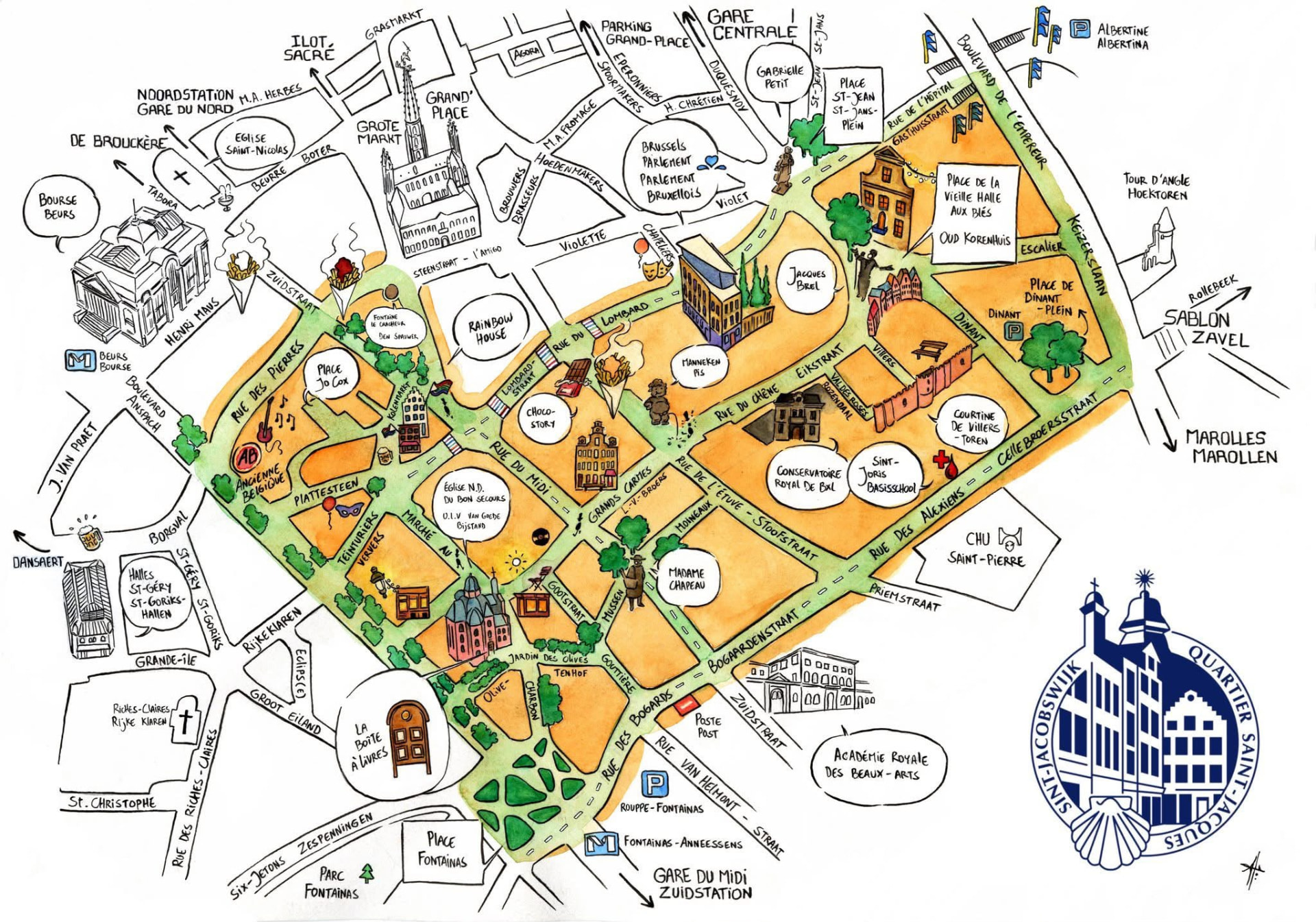
Map of the festival area near Grand-Place
Our recommended walking tour for festival day
A walking loop suggested by our editorial team, starting from the Grand-Place. Allow about 2 hours for a leisurely stroll (estimated times, excluding breaks and terrace stops).
1. Grand-Place → Rue du Chêne — 10 min Leave the Grand-Place via Rue Charles Buls and head down into the heart of the quarter. Landmark: the first listed facades on Rue du Chêne.
2. Manneken-Pis — 10 min Corner of Rue du Chêne and Rue de l’Étuve. Unmistakable landmark: the crowd. This is where the neighbourhood truly begins.
3. Rue du Midi & Rue des Grands Carmes — 20 min Bookshops, coin dealers, instrument shops, and comic book stores. Landmark: the row of old-fashioned shopfronts along Rue du Midi.
4. Notre-Dame du Bon Secours Church — 10 min Rue du Marché au Charbon. Landmark: the Baroque dome, visible from the crossroads.
5. Rue du Marché au Charbon & Rainbow House — 20 min The quarter’s liveliest artery, the historic heart of Brussels' LGBTQIA+ life. Landmark: the rainbow flags.
6. Place Jo Cox & Rue des Pierres — 15 min A breathing space between two narrow streets, a stone’s throw from the Ancienne Belgique. Landmark: the open stage on festival days.
7. Place de la Vieille Halle aux Blés & Courtine de Villers — 15 min The Brussels equivalent of Erasmus’s house and a real piece of the first medieval city wall. Landmark: the stone wall at the end of Rue de Villers.
8. Return via Rue de l’Étuve — 10 min The loop is closed back at the Grand-Place.
Tips for enjoying your visit
- Getting there: Metro Bourse or Anneessens, or a 5-minute walk from Gare Centrale (Central Station).
- Car parks: Grand-Place, Albertine, Dinant, Rouppe-Fontainas (see map below).
- On the day of Les Jacqueries: the area is pedestrianised — use public transport.
- Express version: steps 1, 2, 5, and 7 in 45 min.
Walking times are indicative estimates.
Partage ce scoop 💛
Soutiens BxlPositive — partage l'info à tes amis. Chaque partage compte pour faire grandir les bonnes nouvelles de Bruxelles.
www.bxlpositive.com/articles/les-jacqueries-2026-a-joyful-rebellion-in-the-heart-of-brussels-xelles
WhatsApp et Facebook mettent en cache l'aperçu d'un lien. Le bouton « Partager sur Facebook » ci-dessus génère déjà une URL avec?v=…pour forcer un nouveau scrape. Vous pouvez aussi copier le lien frais ci-dessous.
Do you know a similar initiative in Brussels?
Submit it to the newsroom