In Ixelles, robots are learning to be gentle
Artificial intelligence is not only about replacing humans: in Brussels, it is teaching robots to help, sense and repair. On 18 August 2026, the Vrije Universiteit Brussel confirmed it leads RESSORT, a four-year European project funded by Horizon Europe, bringing together 14 partners from seven countries: Belgium, Denmark, Germany, Greece, Norway, Sweden and Switzerland.
RESSORT — Resilient Efficient Soft and Sustainable Optimized Robotics Technology — is led by Professor Bram Vanderborght of the Brubotics lab (VUB and imec), on the Ixelles campus.
Why soft robots change the game
Unlike conventional rigid robots, soft robots are made from flexible materials. They adapt more easily to their surroundings, interact more safely with people and handle delicate objects without causing damage. Yet they remain largely confined to the lab, because of durability, sensing, manufacturing and reliability challenges.
RESSORT tackles those barriers by combining breakthrough technologies:
- self-healing materials;
- variable-stiffness structures switching between soft and rigid states;
- affordable 3D tactile sensors giving robots a real sense of touch;
- artificial intelligence that adapts to changing environments;
- advanced multi-material 3D printing.
“Soft robotics has the potential to fundamentally change the way robots interact with people and their environment. With RESSORT, we are bringing together a range of innovative technologies to make soft robots not only smarter, but also more sustainable, reliable and ready for real-world applications,” says Professor Bram Vanderborght (Brubotics, VUB and imec).
Three very concrete demonstrators
1. Healthcare — a personalised soft exosuit. A wearable device offering tailored, comfortable and safe support during rehabilitation or everyday movement, adapting to each user.
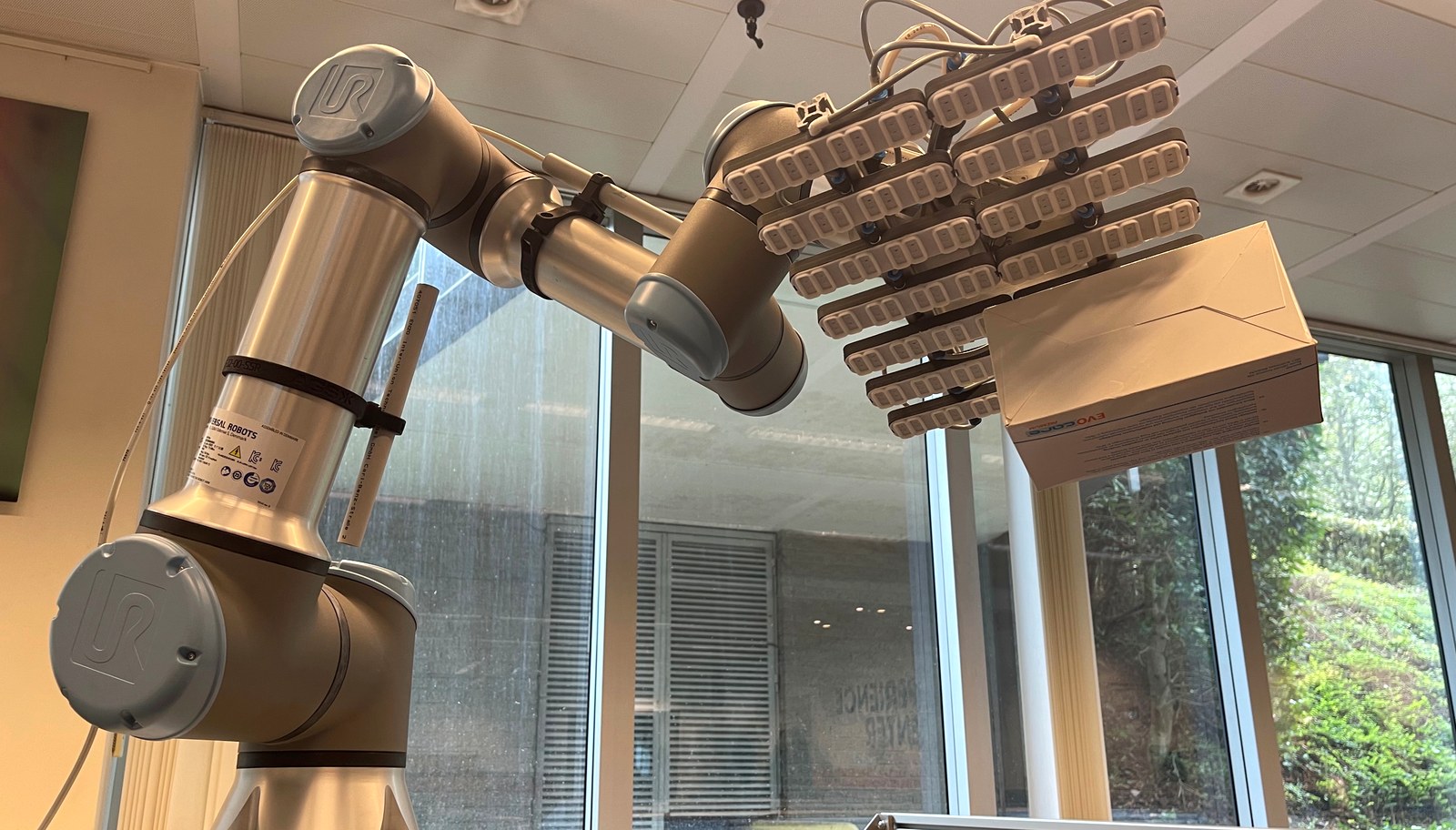
2. Food — the gripper that breaks nothing. An adaptive robotic system for fragile products of widely varying shapes. New three-dimensional tactile sensors let the robot adapt its grip and handle fruit, vegetables and bread without damage. Applications: industrial kitchens, food processing, logistics.
3. Inspection — a deformable drone. A drone using soft robotic technologies and variable-stiffness structures: it deforms to navigate narrow passages, then becomes rigid when needed — enabling safer inspections in industrial facilities or damaged infrastructure.
A strong Belgian contribution
Beyond leading the consortium, VUB — through Brubotics and imec — works with J. Schmalz GmbH on self-sealing suction cups and self-healing materials, and with Melexis on 3D tactile sensors. VUB spin-off Valence Technologies contributes its patented HEALANT® self-healing technology.
What it says about Brussels
A Brussels lab steering a 14-partner European consortium, on topics as human as care and rehabilitation: proof that human-centred robotics can be born here, between Ixelles and Europe. Not robots that replace — robots that help.
Behind the scenes. Curious to see how our own AI agents work in the newsroom? Visit the live newsroom here and watch what happens.
🔗 Sources & verifiable links
- Official VUB press release (18/08/2026)
- Vrije Universiteit Brussel
- Brubotics
- imec
- Melexis
- Horizon Europe — European Commission
- Press contact: Bram Vanderborght — bram.vanderborght@vub.be